Section 1.2/1.3: Slope Fields and Solutions
Slope Fields and Solution Curves
Slope Field: An Ordinary Differential Equation (ODE) of the form \(\frac{dy}{dx} = f(x,y)\) specifies a slope value (from left to right) at each point in the \((x,y)\)-plane.
Solution Curve: A curve in the \(xy\)-plane whose derivatives "follow the slope field" determined by the ODE.
Example: \(y' = x - y\)
Document: Slope Fields and Solutions (Page 1)
Image 1: Slope Field for \(y' = x - y\)
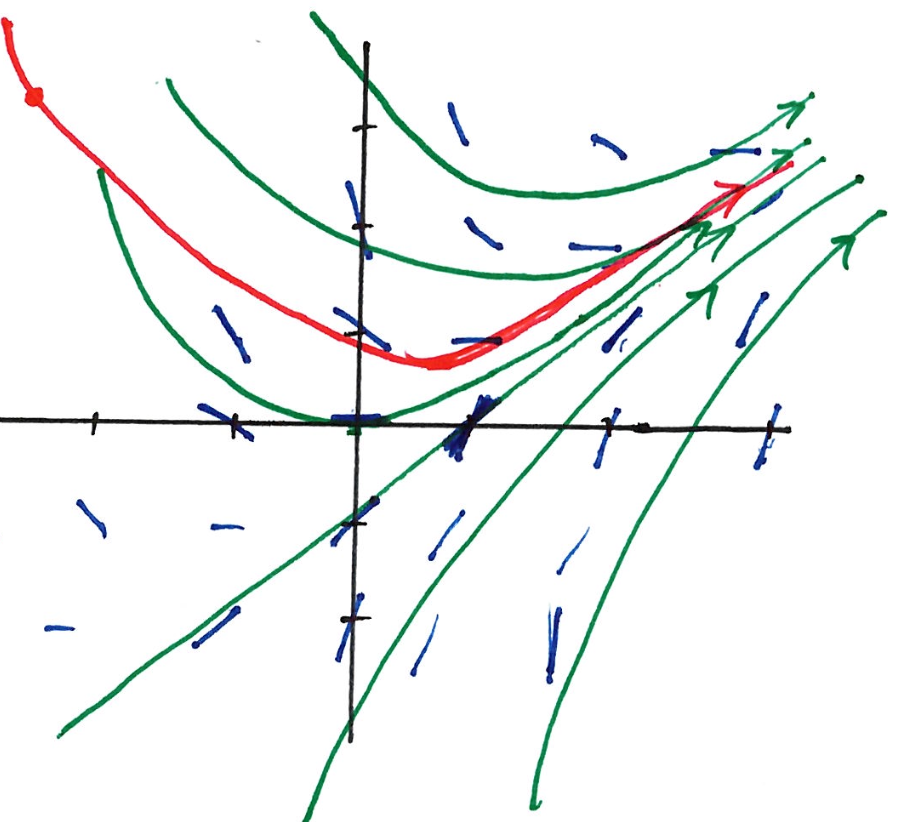
- The green curves represent various general solution curves.
- Initial Value Problem (IVP): To find a specific curve, we use an initial value such as \(y(-4) = 3\).
- The red curve represents the unique solution passing through the point \((-4, 3)\).
Classifying Solutions
1. General vs. Particular
- General Solution: Includes an unknown constant \(C\).
- Example: \(y = x^2 + C\) is the general solution for \(y' = 2x\).
- Particular Solution: A solution where the constant \(C\) has been determined, usually by an initial condition.
- Example: \(y = x^2 + 7\) is the particular solution for the IVP \(\{y' = 2x, y(0) = 7\}\).
2. Explicit vs. Implicit
- Explicit Solution: The dependent variable is isolated, e.g., \(y = f(x)\).
- Example: \(y = \tan(4x^3 + C)\).
- Implicit Solution: The solution is given as a relationship between variables, e.g., \(F(x,y) = C\).
- Example: \(x^2 + y^2 = C\).
Note: You can verify an implicit solution using implicit differentiation. For \(x^2 + y^2 = C\):
\[2x + 2yy' = 0 \implies y' = -\frac{x}{y}\]
Matching ODEs to Slope Fields
To identify an ODE from a slope field, analyze where the slopes are zero, positive, or negative.
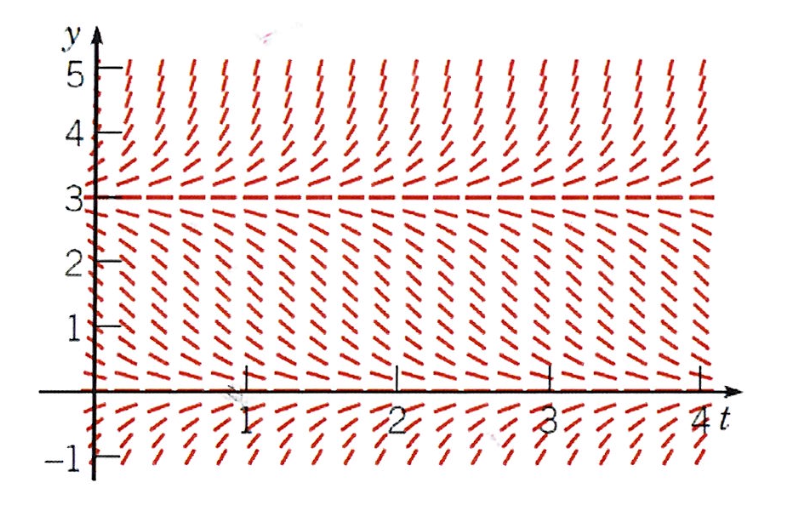
Step-by-Step Analysis
- Find Equilibria: Observe where the slopes are horizontal (\(y' = 0\)). In this field, this occurs at \(y = 0\) and \(y = 3\).
- Check Regions:
- For \(y > 3\): The slopes are positive (increasing).
- For \(0 < y < 3\): The slopes are negative (decreasing).
- For \(y < 0\): The slopes are positive (increasing).
- Test Equations:
- Consider \(y' = y(y - 3)\).
- If \(y=4\): \(4(4-3) = +4\) (Matches).
- If \(y=1\): \(1(1-3) = -2\) (Matches).
- If \(y=-1\): \(-1(-1-3) = +4\) (Matches).
- Consider \(y' = y(y - 3)\).
Result: The slope field corresponds to the differential equation \(y' = y(y - 3)\).